
@misc{sensemakr,
  title        = {sensemakr},
  author       = {Cinelli and Hazlett},
  howpublished = {\url{https://github.com/carloscinelli/sensemakr}},
  note         = {Software / documentation}
}Don't just assume no unobserved confounding — quantify it: robustness value + contour plots benchmarked against your real covariates.
Input · what goes in
A fitted OLS outcome model: outcome ~ treatment + observed covariates.
Show data format & exampleHide example
Format — one row per unit: outcome Y, treatment D, covariates X.
   Y     D   X1   X2  ...
 3.2     1  0.4  -1.1
 1.8     0 -0.1   0.6
Pipeline · the recipe ⑂ has parallel branches
↑ Click any step in the diagram to read its logic, code, assumptions & discussion.
Fit the OLS outcome model
Data preparation — shapes the raw inputs into what the estimator expects.
Outcome ~ treatment + observed covariates.
fit <- lm(peacefactor ~ directlyharmed + age + female + ..., data = darfur)
- No comments on this step yet — be the first.
Log in to comment on this step.
[sensemakr] Sensitivity to unobserved confounding
The core estimate — where the causal quantity itself is computed.
Compute the robustness value and partial-R² sensitivity statistics.
Sensitivity to unobserved confounding — How strong would an unobserved confounder have to be to overturn your OLS result? Robustness values + contour plots, no extra assumptions.
s <- sensemakr(fit, treatment = "directlyharmed", benchmark_covariates = "female", kd = 1:3)
- No comments on this step yet — be the first.
Log in to comment on this step.
Contour plot — point estimate
Reporting — turn the numbers into a figure or table a reader can act on.
How strong must a confounder be (vs observed covariates) to drive the estimate to zero?
plot(s)
- No comments on this step yet — be the first.
Log in to comment on this step.
Contour plot — t-value
Reporting — turn the numbers into a figure or table a reader can act on.
Same, for statistical significance.
plot(s, sensitivity.of = "t-value")
- No comments on this step yet — be the first.
Log in to comment on this step.
Output · what you get 3 figures
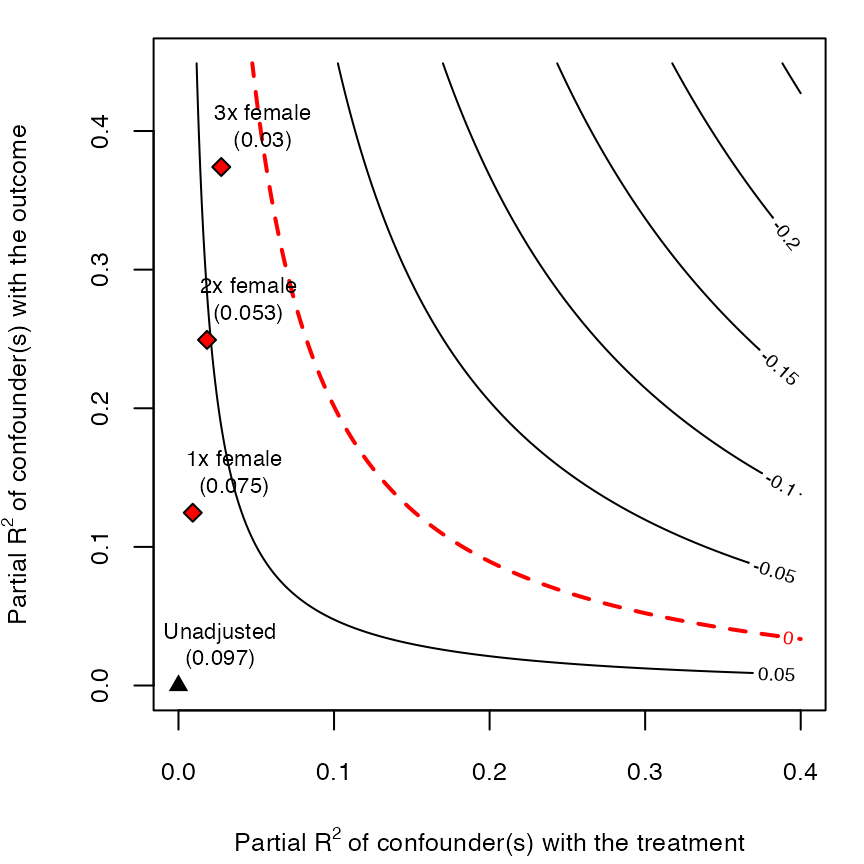
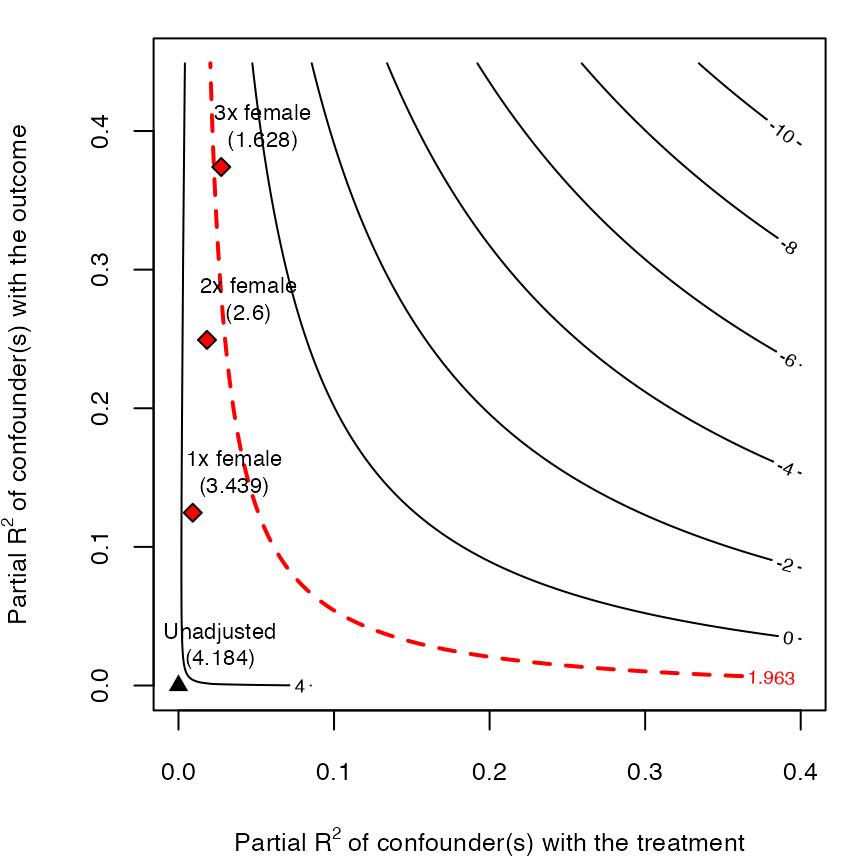
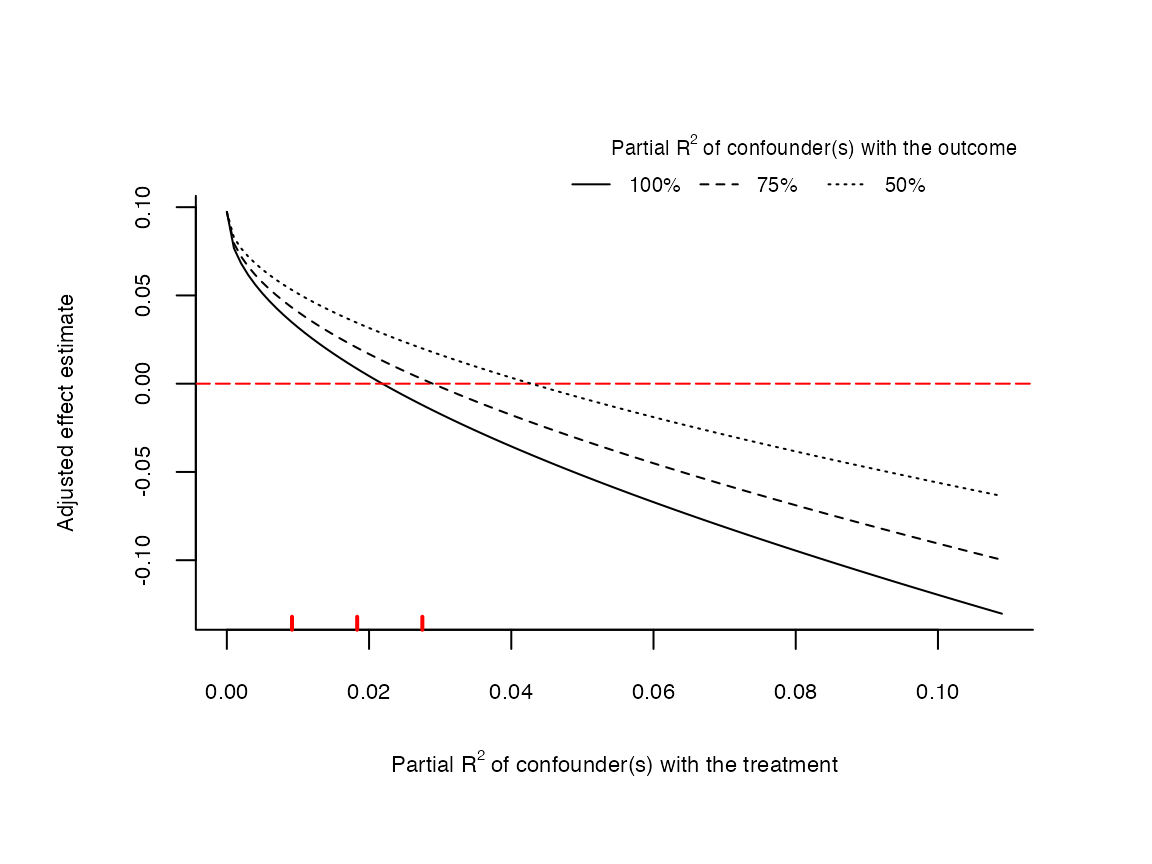
Figures reproduced from sensemakr — Cinelli & Hazlett — unofficial community showcase; all credit to the original authors.
The sensemakr vignette (Cinelli & Hazlett). Fit your model, then report how strong hidden confounding would need to be to change the conclusion. Unofficial summary.
Discussion (2)
Log in to join the discussion.
Unconfoundedness is an assumption, not a fact. sensemakr makes you state HOW wrong you could be. Every observational paper should include this.
The robustness value is such a clean one-number summary. 'A confounder would need to explain 15% of residual variance to overturn this.'
Benchmarking against observed covariates is the killer feature — 'as strong as 3× the effect of female' is interpretable.